“Expanding America’s Diverse History Inside the Sierra Summit Tunnels” by Terry Guen Featured in The Field publication by ASLA
March 20, 2019

Advisory Council on Historic Preservation (ACHP) Expert Member, Terry Guen, wrote an article about her recent volunteer efforts with the advisory council. The insightful article published in The Field, the American Society of Landscape Architects' Professional Practice Networks Blog, deals with the challenges and achievements of Chinese workers during the construction of the Transcontinental Railroad in the 1860s.
41st Street Pedestrian Bridge
May 4, 2018

Owner: Chicago Department of Transportation
Client: AECOM
Design Architect: Cordogan Clark
Meso Chicago by Terry Guen Design Associates is now on display at the Chicago Architecture Foundation.
October 10, 2017

TGDA was one of the 50 design firms invited by the CAF to participate in the 2017 Chicago Architecture Biennial Exhibition- Between States.
Boston Chinatown’s Quincy School Designated into the National Registry of Historic Places
August 24, 2017

On Sunday, August 13, 2017, Boston's Mayor Marty Walsh announced Chinatown's Josiah Quincy School has been listed on the US National Register of Historic Places. The Mayor was joined at the opening celebration of the 48th August Moon Festival, by representatives of Boston's Chinatown Community, the National Park Service, the Massachusetts Historical Commission, and Terry Guen, representing the US Advisory Council on Historic Preservation (ACHP).
MILLENNIUM PARK PANEL & WALKING TOUR – FROM CONCEPT TO ICON
June 16, 2017
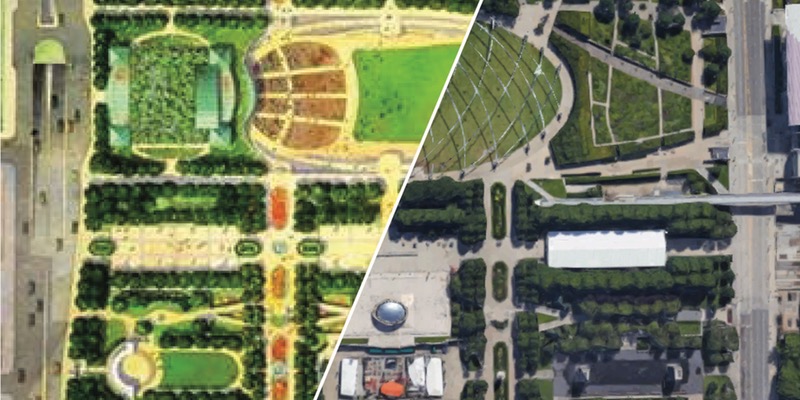
On Thursday, June 29th, Terry Guen, FASLA will be sharing rare “insider’s view” of the construction process of Millennium Park. As the master landscape architect for the project, Terry will be joining Ed Uhlir, Millennium Park Inc., Benet Haller, AICP, and Christy Webber, Christy Webber Landscapes, for a panel discussion and guided walking tour. We hope to see you there!
TERRY GUEN SHARES INSIGHT ON TGDA’S TEAM APPROACH IN RECENT INTERVIEW WITH THE CHICAGO TRIBUNE
June 8, 2017

On June 8th, 2017 Terry Guen was profiled and interviewed by Kate MacArthur in the Chicago Tribune’s Blue Sky Innovation Section. The creative class Q&A series features top innovators and creative leaders from the city's marketing, design, arts, and engineering professions and will run over the coming weeks.
TGDA part of award-winning team for MWRD’s Green Infrastructure Plan
May 9, 2017
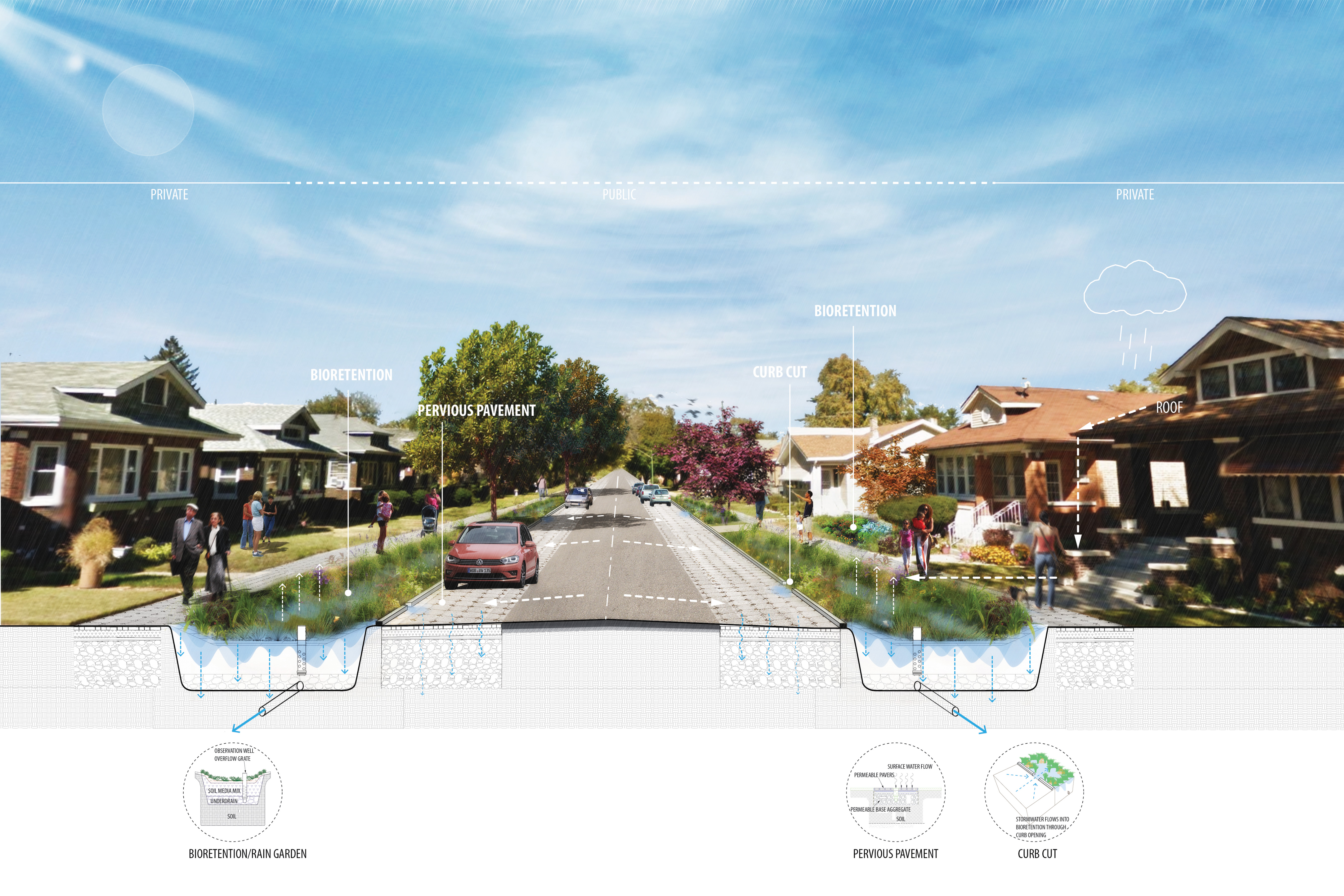
The MWRD pilot stormwater management project was awarded the Innovation Project of the Year by the Illinois Association for Floodplain and Stormwater Management (IAFSM) 2017.
World Landscape Architecture Month; #WLAM2017
May 4, 2017

As Spring takes hold in the Chicago region and the landscape shifts from grey to green, TGDA with our colleagues celebrated World Landscape Architecture Month (#WLAM2017).
TGDA SHARES WATER MANAGEMENT EXPERTISE WITH BIOMIMICRY CHICAGO
March 9, 2017

On March 9th Aaron Elswick (TGDA) was invited to kick-off the discussion on water management at Biomimicry Chicago’s Thirsty Thursday March Event.
TGDA SERVED ON CITY OF CHICAGO SUSTAINABLE DEVELOPMENT POLICY COMMITTEE
February 9, 2017

TGDA was honored to be invited to serve on the advisory committee for the new Chicago Sustainable Development Policy.
TGDA INVITED SUSTAINABILITY EXPERT @ THE EPIC SUSTAINABLE NEIGHBORHOOD YOUTH CHALLENGE: CHICAGO BOULEVARD SYMPOSIUM
January 14, 2017

The US Green Building Council-Illinois Chapter (USGBC-IL), Civic ArtWorks and the Peggy Notebart Nature Museum teamed up to host Chicago high school and middle school students to re-imagine the historic Chicago boulevard system as it relates to a community asset near their schools.
CANAL ORIGINS PARK BOATHOUSE, CHICAGO PARK DISTRICT #571 OPENS!
December 4, 2016

TGDA attended the public opening of the Canal Origins Park Boathouse, aka the Chicago Park District #571, on a cold and snowy Chicago day this past December. The new 3 acre park and boathouse is located in Chicago’s Bridgeport neighborhood and is the final of four new boathouse sites along the Chicago River.
TGDA INVITED AS GUEST LECTURER FOR DEPAUL SOCIOLOGY CLASS
October 13, 2016

Laura was thrilled to be a guest lecturer for DePaul Sociology Professor Anthony Ippolito’s class: Plants, Chicago and the Rest of Society. The class was reading one of her favorite books, Michael Pollan’s The Botany of Desire, and for the chapter on Tulips, she provided a Landscape Architect’s perspective on how plants and flowers are used as part of the LA’s toolbox.
TGDA REATREATS TO THE INDIANA DUNES FOR THE FALL 2016 DESIGN FOR LIFE TRIP
September 23, 2016

On Friday September 23rd, 2016 TGDA took an ecological field trip to the Indiana Dunes. Hiking the Cowles Bog Trail the team sketched and observed natural conditions that define the National Park. The focus of the trip was to improve the team’s ability to read the landscape.
THE UNIVERSITY OF CHICAGO NORTH RESIDENCE HALL & DINING COMMONS GRAND OPENING
September 12, 2016
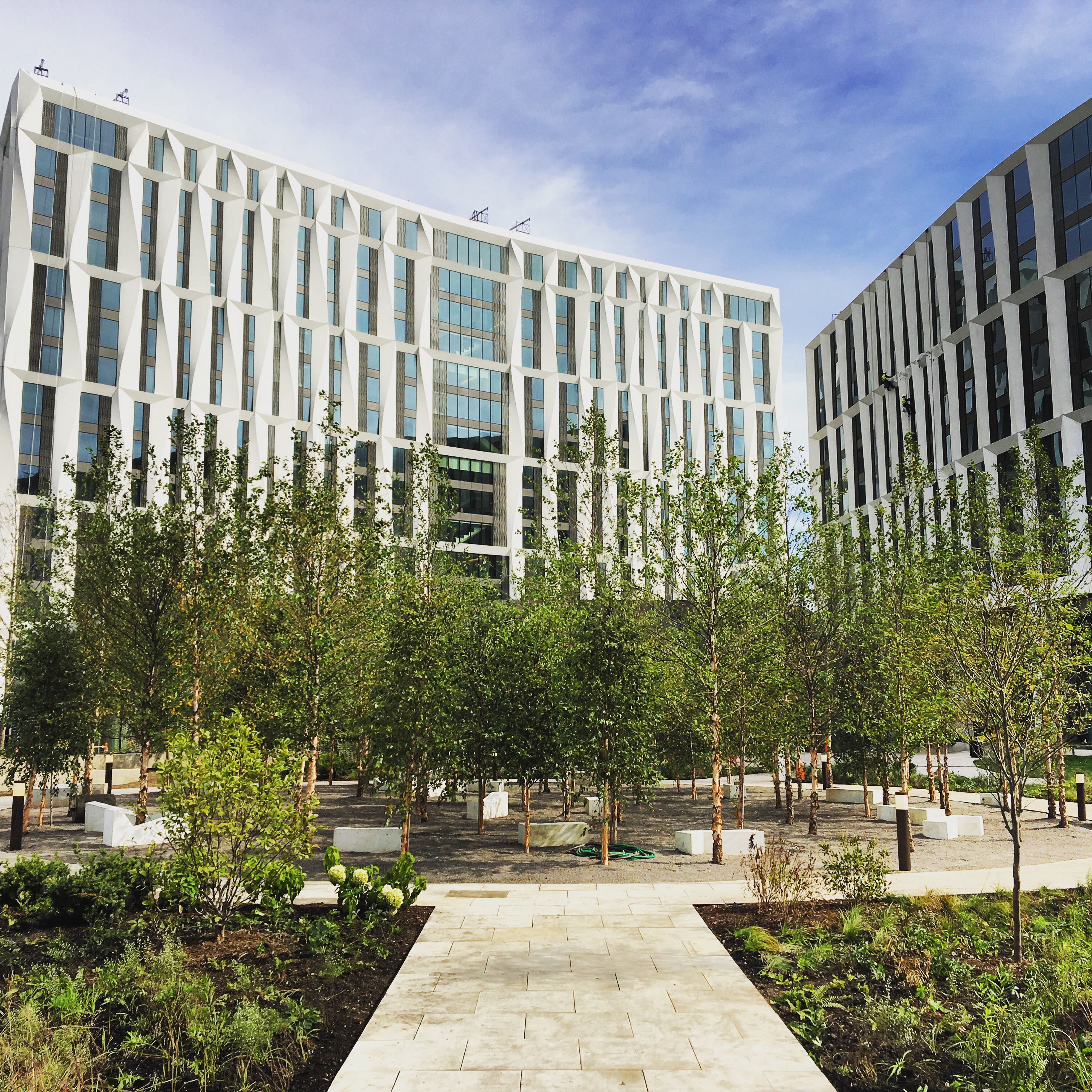
On Monday, September 12th, 2016 TGDA attended a celebratory dinner at the new Dining Commons at the University of Chicago. In attendance were representative from the direct collaborators on the project including but not limited to The University of Chicago, Mortenson Construction, Studio Gang, and David Mason and Associates. This was the last chance for the design team to experience the project before students are admitted and access is restricted. TGDA is thrilled with the outcome of the project and would like commend Studio Gang Architects and rest of the team on a job well done.
TGDA PART OF WINNING TEAM FOR INTERNATIONAL DESIGN COMPETITION IN CHONGQING, CHINA
August 30, 2016

In collaboration with NewGround Engineering, Shenzhen, China and MS Consultants, Ohio USA, Terry Guen Design Associates won the International Sponge City Green Infrastructure Design Competition for Overseas Chinese Town (OCT) Chongqing, China.
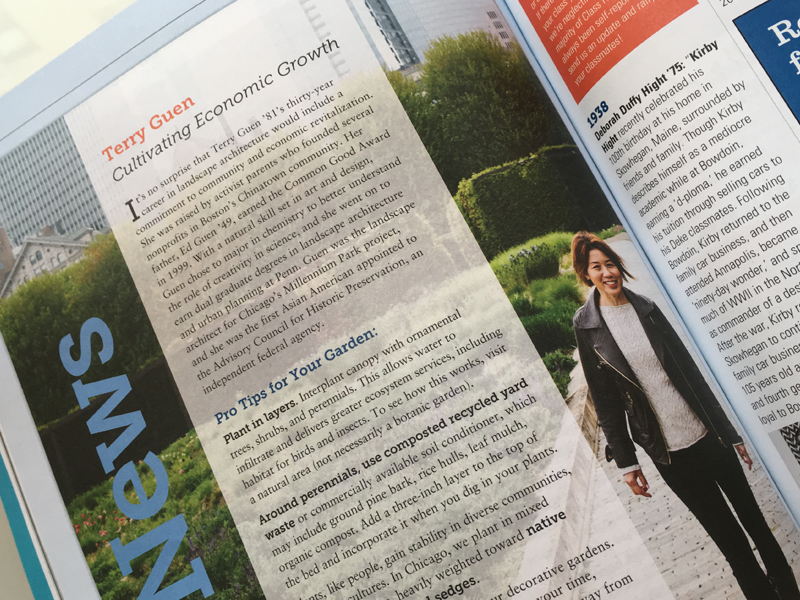
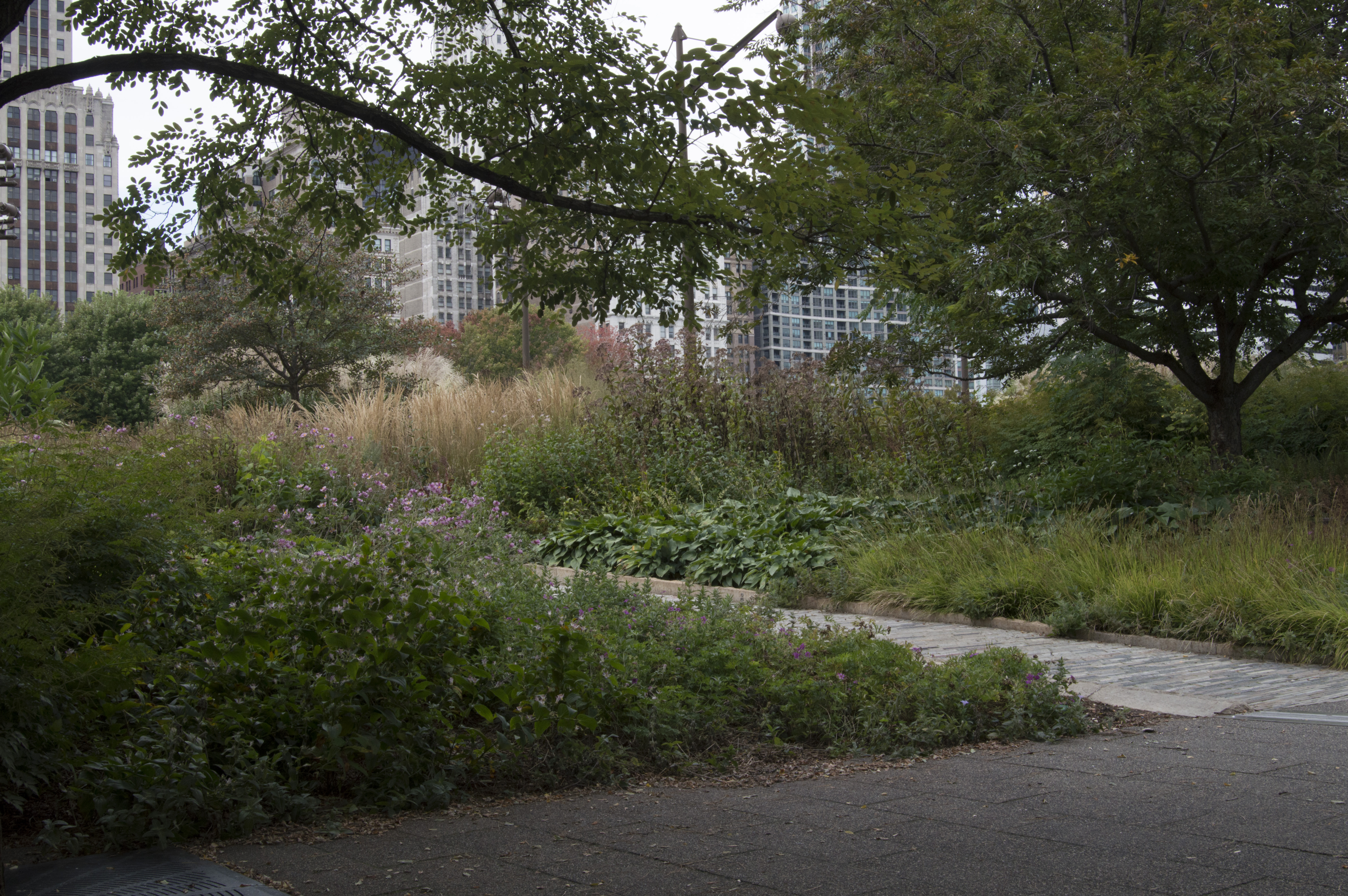
TGDA’S PROJECT UNO GALEWOOD CHARTER SCHOOL WINS 2016 AMERICAN ARCHITECTURE AWARD
August 10, 2016

The Urban Work’s designed building was selected by the Denver based jury as one of the 74 best new buildings designed and constructed by American architects. The American Architecture Award is the nation’s highest public award given by a non-commercial, non-trade affiliated, public arts, culture and educational institution.
Terry Guen Re-appointed to Advisory Council on Historic Preservation
August 9, 2016

On July 27th TGDA principal and founder Terry Guen was re-appointed by President Obama as member and expert to the Advisory Council on Historic Preservation. As Sustainability Chair of the Preservation Initiatives Committee, Terry initiated interagency preservation and sustainability presentations for Agency representatives to share knowledge and strategies.
Bronzeville Arts and Recreation Center at Ellis Park Opens
July 27, 2016

After more than a decade of planning, the new Bronzeville Arts and Recreation Center at Ellis Park opened its doors to an enthusiastic community. Terry Guen Design Associates worked with Booth Hansen Architects and NIA Architects to integrate the landscape with the building design, capturing stormwater with two green roofs and a large infiltration swale planted with grasses and Bald Cypress trees.
Construction Underway at the University of Chicago North Residential Commons
July 18, 2016

TGDA is thrilled to announce that site construction is underway for the University of Chicago Campus North Residential Commons. It has been an honor to work alongside such a talented team including Studio Gang Architects, Mortenson Construction and David Mason and Associates. We were fortunate to have the opportunity to, along with Studio Gang, help realize the design of landscape architect Walter Hood and Hood Design Studio’s vision for the new centerpiece of the University’s north campus. For more information on the design of the building, please follow this link. Due to the rigorous schedule of the project, the entire site is planned to be fully constructed in under three months. Check back here for more updates!
TGDA Named Finalist in Philadelphia Play Space Competition
June 2, 2016

Terry Guen Design Associates recently entered the Play Space design competition hosted by the Community Design Collaborative and Delaware Valley Association for the Education of Young Children. The interdisciplinary design competition aimed to promote innovative outdoor play spaces for Philadelphia and other cities. TGDA’s entry “Co-Play” was selected as one of the three finalists for the Haverford Bright Futures site. Terry Guen and Ben Cole presented TGDA’s proposal at the Infill Philadelphia Play Space Design Awards event on March 16, 2016. For more information on the competition and TGDA’s entry please follow the link.
Prairie Planting for Joseph F. Glidden Homestead
February 4, 2016

Laura DeMink, Senior Associate with TGDA, has been involved with preservation efforts on the Joseph F. Glidden Homestead and Historical Center in DeKalb, Illinois for the past two years. Her Great-Great-Great Uncle, Joseph Farwell Glidden, invented, patented, and initially manufactured the first practical barbed wire that became known as “The Winner” on the site in 1874.
CMAP Climate Resilience Resource Group
December 1, 2015
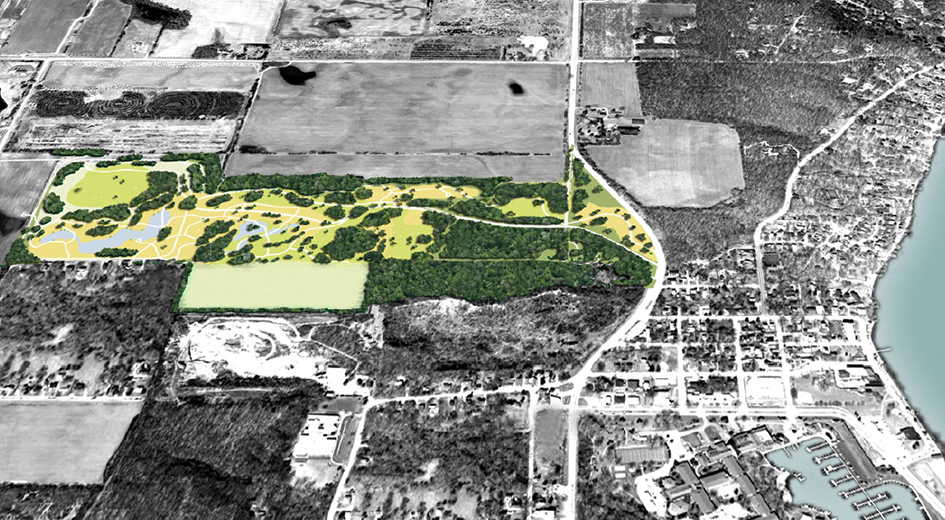
Terry Guen Design Associates is an active member of the Chicago Metropolitan Agency for Planning’s (CMAP’s) Resilience Resource Group. This group of subject-area experts is engaged to provide input and shape CMAP’s work to develop strategies to promote Climate Resilience in the Chicago region. Climate change will have far-reaching effects on our region and TGDA is proud to play a leadership role to develop solutions help mitigate potential social, environmental, and economic impacts.
Thornton Reservoir is Operational
November 26, 2015

On November 26, 2015 the Thornton Reservoir experienced its first rush of stormwater and sewage, with 400 million gallons flowing into what is described as “Chicago’s Grand Canyon,” captured in this amazing video. At its maximum capacity the reservoir can hold 7.9 billion gallons. Terry Guen Design Associates has been helping to design and build the landscape adjacent to the reservoir since 2012. We are excited to see the reservoir come online to increase the region’s capacity to manage stormwater and prevent combined sewage from flowing into our area’s waterways.
Maggie Daley Park Completed
November 22, 2015

TGDA is proud of all the dedication and effort that contributed to the recent completion of Maggie Daley Park. Plant installation just concluded in Fall 2015 and the whole park is now accessible to residents and visitors. Working as part of a team with Michael Van Valkenburgh and Associates on this 26 acre park allowed TGDA to refine its skills and expertise in building dynamic landscapes, which we will continue to apply on all future projects.
University of Chicago North Residence Hall & Dining Commons In Process
November 20, 2015

TGDA is excited to announce that the new design for the landscape surrounding the recently built University of Chicago’s residence and dining halls will be completed in Summer 2016. TGDA worked with Studio Gang Architects to create a healthy, vibrant landscape that integrates the larger community with campus life and provides social amenities for students, such as ample outdoor seating and larger gathering spaces. Visit the live webcam here.
TGDA PROJECTS FEATURED IN PLANTING IN A POST-WILD WORLD
November 1, 2015
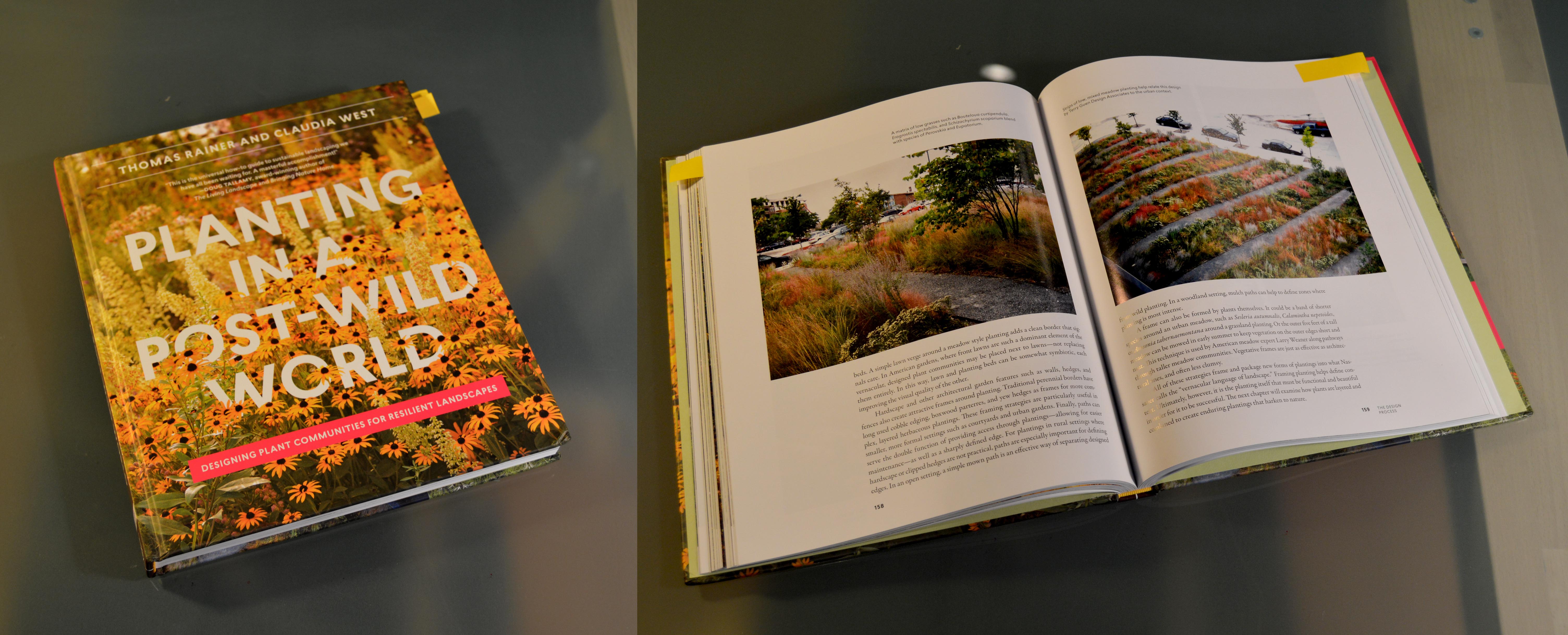
Planting in a Post-Wild World: Designing Plant Communities for Resilient Landscapes by Thomas Rainer and Caudia West, features 2 of TGDA's projects.
TGDA turns 15!!
December 20, 2014
TGDA is honored to announce the milestone of our 15th year of sustainable design leadership throughout Chicago and the Midwest. We extend our thanks and gratitude to all owners and colleagues who support our work.
TGDA has designed more than 70 built projects in the Chicago Region, transforming the ecological makeup and experience of more than 5,200 acres. This is a testament to the significant impact one firm can have on the local and regional landscape. According to calculators sourced from the Landscape Architecture Foundation, we found that the 2,800 trees TGDA has planted have captured roughly 1,157 metric tons of carbon dioxide and mitigated approximately 508,480 sq ft of stormwater run-off. TGDA looks forward to continuing our contributions towards solving future social and ecological challenges and sharing our results with our colleagues.
McCormick Place Event Center and Hotel
December 10, 2014
TGDA served as the design Landscape Architect two separate but adjacent expansion projects for the Metropolitan Pier & Exposition Authority's (MPEA) McCormick Place Convention Center: the event center arena (led by Pelli Clark Pelli Architects) and a hotel and retail complex (led by Gensler). The project includes a new basketball arena/event center space to serve the growing Chicago convention market and DePaul University students, as well as a new Marriott Hotel. The neighborhood will benefit from a new park also designed by TGDA which will include play spaces, garden areas, and a dog run, included as a part of the hotel streetscape design.
TGDA's goal for each project was to create a holistic site to maximize and build upon the existing streetscape and urban design vocabulary of the McCormick Place Convention Center Campus, as a desirable place to visit, while also incorporating aspects of the adjacent historic residential neighborhood. The challenge was to knit the framework into the existing residential community, creating an open space amenity for both visitors and residents. The design is intended to create memorable places of cultural interest located at walkable intervals.
As part of this work, the historic Rees Home was relocated. View a time lapse of the Rees Home relocation here.
Maggie Daley Park
December 1, 2014
As the New Year approaches, Maggie Daley Park is well underway. The skating ribbon is in its final stages, play equipment and surfacing is being installed, and the climbing wall structure is taking shape. As the local landscape architect, TGDA has been assisting Michael Van Valkenburgh's office with construction administration throughout 2014, and will continue with this effort again in the spring.
Although the official opening date is still to be determined, Maggie Daley Park is quickly becoming a place for Chicagoans to enjoy for years to come. Click the link. to view the construction progress through the Chicago Park District webcam website. Maggie Daley was also covered by Blair Kamin in the Chicago Tribune, link here.
TGDA to participate in LAF’s CSI Program
March 1, 2013
TGDA is excited to announce our participation in the Landscape Architecture Foundation's Case Study Investigation Program. This is a unique program that links designers with researchers to "document exemplary and high-functioning landscapes." TGDA's built project, 63rd St. Beach at Jackson Park, will be researched and studied by the 2013 Reserach Fellow selected by LAF. TGDA is fortunate to be a participant in this innovative new program within the growing landscape architecture field. Check into the LAF blog for project updates and information on other participants.
Sustainable Woodard Plaza receives funding
February 21, 2013
The TGDA led sustainable plaza project for the Chicago Department of Transportation is moving forward to construction. The project involves the closing of a small, under-utilized arterial street in order to transform the space, currently a mass of pavement with scarce vegetation, into a pedestrian-friendly outdoor space. The urban green space utilizes innovative stormwater management techniques, which are incorporated into the details of the planters and public gathering spaces. Stay tuned for more developments.
Coverage by the Milwaukee Avenue Green Development Corridor here.
Terry speaks at Chicago Architecture Foundation
January 21, 2013
Terry was invited to speak at the CAF sponsored Lunch Talks@CAF: Architecture is Activism. The talk entitled "Ecology and the Urban Landscape for Social Change, Creating Chicago's Urban Ecological Design Legacy highlights Terry's background and design approach, and how TGDA has contributed to Chicago's Ecological Legacy. Download and listen to the podcast of the entire talk here.
Dearborn St. Two-way Bike Lane Opens outside TGDA’s office
December 21, 2012
TGDA is excited to have the first two-way bike route in Chicago, provided right outside our office! The bike route is protected from vehicular traffic by a no-travel zone and a parking lane. The bike lane will run on Dearborn Street from Polk St. to Kinzie St., providing a key bike route connection through the heart of the Loop. We applaud CDOT for this effort and look forward to testing them out.
More in the press here:
Grid Chicago
Red Eye Chicago
UNO Galewood Charter School Opening
November 21, 2012
Designed and constructed in 10 months,TGDA's second project with the United Neighborhood Organization (UNO) opened this Fall with strong community support. The landscape serves as an aesthetic campus to promote outdoor activities, enriching the urban habitat, while managing project stormwater needs. Working with the team of Urban Works Architecture and FH Paschen, this design-build effort has proved to be efficient and cost-effective.
TGDA Projects Featured in Chicago’s 2015 Sustainable Action Agenda
September 21, 2012
The recently released 2015 Sustainable Chicago Action Agenda, features current and ongoing TGDA projects as examples of the City's 7 design goals, including The Ogden International Elementary School, the Lexington Pump Station, Chicago Navy Pier, The Lurie Garden and Millennium Park, O'Hare Airport and the Goose Island Recycling Center.
TGDA is part of team selected to redesign Navy Pier
March 21, 2012
TGDA is pleased to be a member of the James Corner Field Operations team for the redesign of Navy Pier as the local landscape architect for the project. The interviews and presentations by all the short-listed teams were impressive and imaginative.
Follow the link to the official announcement, and the local news coverage from the Cityscapes blog by Blair Kamin. TGDA is looking forward to working with the diverse and talented design team.
TGDA is moving on January 6th to Printer’s Row
January 21, 2012
As of Friday, January 6th, 2012, TGDA will have a new office space to call home at: 714 S Dearborn St. #5, Chicago, Il 60605
TGDA awarded University of Illinois at Chicago Landscape Architect Retainer Contract under CYLA Design Associates Team
October 21, 2011
The CYLA/TGDA team is has been selected to fill any landscape architectural service needs for the duration of one year. TGDA is looking forward to working with CYLA for the University, in the advancement of their comprehensive master plan.
PBC Receives 2011 Engineering News Record Award Of Merit For Ogden International School Of Chicago
October 10, 2011
The Ogden International School of Chicago owner, the Public Building Commission of Chicago, received an award of merit shortly after opening this fall. From the PBC website: Ogden International School of Chicago was designed to achieve LEED Silver Certification from U.S. Green Building Council. In addition to implementing LEED practices in design and construction, specific elements include the design and utilization of green roofs throughout, a storm water harvesting system for landscaping irrigation, photovoltaic glazing panels at the library feature window, and a kiosk monitoring the performance of these elements in real time that can be used as an instructional tool for students. TGDA's contributions to the project can be viewed here.
TGDA’s contributions to the City of Chicago’s “Adding Green to Urban Design” Publication recognized
September 21, 2011
The City of Chicago Planning Department has received a National ASLA Honor Award this year for the preparation of the Green Urban Design guidelines in the Planning and Analysis Category for their publication "Adding Green to Urban Design." Terry Guen participated in meetings, research, and provided landscape architecture review looking specifically at the indicator section of the report. TGDA is honored to be able to participate in this innovative framework plan and to be recognized by the City as a project resource.
New UNO Charter Elementary School Opens With a Bang
September 11, 2011
The grand opening of the UNO Charter Elementary School at 51st St. and Homan Ave. was attended by Illinois Governor Pat Quinn and Chicago Mayor Rahm Emanuel. TGDA's landscape design features a central courtyard and play area, various perennial planting beds, and nearly 70 trees spread over 3 acres.
See the WBEZ coverage here:
Shiny charter school for the Southwest Side
By Linda Lutton
Terry Guen nominated to serve on the federal Advisory Council on Historic Preservation (ACHP)
July 21, 2011
Terry is honored to have been appointed by President Barack Obama, as a member of the federal Advisory Council on Historic Preservation. She is the second landscape architect to serve on the Council since Lawrence Halprin, who was appointed by President Lyndon B. Johnson, to the first Advisory Council in 1967. Terry looks forward to contributing her expertise in sustainable design, landscape and urban design to the Council, which advises national policy and promotes preservation, enhancement and sustainable use of America’s Historic resources, including the America’s Great Outdoors Initiative.
See the press announcements here:
By Blair Kamin at the Chicago Tribune
By Lynn Sweet at the Chicago Sun Times
TGDA receives 2 Illinois ASLA Awards
May 21, 2011
TGDA was recognized for two projects in this year's round of Illinois ASLA awards. Boulemorphosis: 100 Year Urban Landscape Design Plan for Chicago received an Honor Award. Reviewer comments for the award included:
"Great graphic communication"
"Thoughtfulness on this project shines through"
"Respect the large scale endeavor with planning, effort, and detail at a very involved level"
Sustainability from the Ground Down-South Chiller Plant received a Merit Award. Reviewer comments for this project included:
"Gutsy use of granite and nice reference to industrial nature"
"Innovative mulching-very successful"
"Bold design and use of perennials"
See the projects here:
Boulemorphosis
South Chiller Plant
TGDA Landscape Architect for the Rockford Linear Park
June 21, 2010
Terry Guen Design Associates was selected for the design of the Rockford Linear Park along West State Street/US-20.
The community design process begins! Learn more at:
Rockford Register Star
Design Outcomes
TGDA at the Illinois Park & Recreation Association Conference – January 28-30, 2010
January 10, 2010
TGDA is pleased to be one of the conference exhibitors at the 2010 Illinois Park & Recreation Association Conference, January 28-30 at the Hilton. You can find us at booth (#1712)
Terry Guen will be giving a lecture on Ecological Park Master Planning: Living History in Joliet’s Pilcher Park. Time and Location: 10.30am - 11.45am Conference Room 4F, 4th Floor
This session will include a case study of the Ecological Park Master Plan Process for this 600-acre historic park site, including future facilities planning and natural areas protection for the high quality forest, Hickory Creek Watershed and Pilcher Park Nature Center, Barber and Oberwortmann Horticultural Center.
Participants will: (1) have a greater understanding of how site ecology and historic resources can provide a basis for site planning and contribute to a stronger sense of site identity; (2) have a greater understanding of how ecological planning decisions can be the basis for sustainable site management practices.
TGDA Landscape Architect for the Cal-Sag Trail Master Plan
December 21, 2009
Terry Guen Design Associates as part of a team with Townbuilder Studios, Carol Naughton Associates and McDonough Associates, was selected for the design of the Cal-Sag Trail Signage and Open Public Spaces Master Plan.
TDGA will head efforts to establish the type, size and location of a series of public spaces to be proposed within the Calumet-Sag Trail Corridor. The nature of these public spaces will be determined through public participation processes, which may include key person interviews, user surveys, focus group research, visioning exercises, design charrettes, and public hearings.
Based on the consensus derived from the public participation process, with review and approval of those points of consensus by the City, TGDA will develop conceptual designs of the public spaces proposed within the corridor. These designs will achieve relevance and authenticity in relation to the communities within which they are located, while employing a design vocabulary and materiality that knits the various public space elements into the unified whole of the Calumet-Sag Trail. In all instances public spaces would be sited in a manner sensitive to the constraints of existing woodlands, wetlands and habitat. The design process will take into account the proposed site improvements of the current Multi-Use Trail Project, which will specify such aspects as comfort stations and site furnishings.
Click here to go to the website of the Friends of the Cal-Sag Trail
TGDA receives IL-ASLA Service Award
December 10, 2009
TGDA receives a Community Service Award for organizing the Burnham 100x100 Charrette as part of the Burnham Centennial Celebrations.
On July 16th, 2009, over 100 enthusiastic landscape architects, designers, not-for-profit and agency members, and students joined together at the Chicago Cultural Center for a one-day historic charrette, to sketch, create ideas for, and shape the future green space visions of Chicago. Conceived by Terry Guen Design Associates, and supported by the Burnham Plan Celebration and IL-ASLA, principal designers of leading firms collaborated in presentations and leading design efforts at eleven work tables. Firm Principals opened the proceedings with a “visual warm-up” relaying visions of the role of landscape architects in the next fifty years. Diverse topics for the “visual warm-up included: breaking historic open space design paradigms, landscape architects in planning leadership positions, and what to expect when designing for an Olympics.
Principals then led design discussions including themes: A Plan for Trees, River Networks, Industrial Retrofit, Urban Agriculture, and City Lot Use. The well orchestrated day was concluded with each group presenting the multitude of ideas and sketches during the Charrette Happy Hour. Initial feedback from participants for the event was enthusiastic, tremendously positive, and included interest in future similar events. Additionally, there was generous feedback regarding the amount of information learned from experts, and also highlighted the networking opportunities for colleagues to meet as a community.
Charrette ideas were utilized as the basis for renderings to be included in the Burnham Plan Centennial’s September Exhibit, “Big Bold Visionary: Chicago Considers the Next Century”.
OWPP/CANNON Design Team awarded the CPS Design Manager Contract, TGDA included as Landscape Consultant
November 21, 2009
The Board of Education contracted the innovative, multi-disciplinary OWP/P Team to assist the Board in the continuation of its Capital Improvement Program. The Chicago Public School Capital Improvement Program (CPS/CIP) is an extensive effort to improve school facilities in Chicago. Under the leadership of Mayor Daley, the CPS/CIP began in 1995 and has invested over $4 billion in the Chicago Public Schools. The board anticipates maintaining a $300 million per year—or more— Capital Improvement Program to carry out this initiative.
TGDA will be assisting the team with development of Scope Assessment, Landscape Design, and Sustainable Management Strategies.
SOM and Design Team receive Chicago AIA Urban Design Award for Chicago Riverwalk Main Branch Framework Plan
November 11, 2009
SOM and Design Team developed an actionable plan with specific recommendations to guide a multi-year implementation program along the Main Branch of the Chicago River. The plan includes guidelines for the construction of a continuous walkway from Lake Michigan to Lake Street, extending an existing path, as well as ramp and elevator improvements to establish universal access between street and river levels, loading and storage spaces to support riverside business operations, and habitat improvements, along with conceptual designs for a new green space, public market, and pedestrian bridge.
Prime / Architect: Skidmore, Owings & Merrill LLP
Client: City of Chicago, Depts. of Zoning & Planning and Transportation
Consultants: Goodman Williams Group (economics); Terry Guen Design Associates (landscape); STS/AECOM (engineering); Construction Cost Systems Inc./Owner Services Group (cost estimating)
TGDA part of the MVVA Team to re-design Northeast Corner of Grant Park
November 1, 2009
The Chicago Park District Board of Commissioners recently approved a professional services agreement with the landscape architecture firm of Michael Van Valkenburgh Associates, Inc. for the design and construction administration services for the North Grant Park Renovation Project.
Michael Van Valkenburgh Associates, Inc. is well known for notable projects such as Teardrop Park in New York City, Bailey Plaza Park at Cornell University and Brooklyn Bridge Park in New York City to name a few.
TGDA is excited to be part of the team and will assist MVVA with landscape design, construction documents and construction administration.
Terry Guen becomes Fellow of the American Society of Landscape Architects
September 21, 2009
The American Society of Landscape Architects (ASLA) announced July 21, 2009 the selection of Terry Guen among 33 members for induction into its distinguished Council of Fellows, among the highest honors the Society confers. Fellows are recognized for their exceptional work, leadership, knowledge and service to the profession over the course of their careers.
The “Fellows-elect” had to wait for the formal investiture proceedings on Sept. 19 at the Chicago Hilton before officially applying “FASLA” to their names, a distinguished addendum readily noted by their peers.
Planting of the University of Chicago – South Campus Chiller Plant has started
September 1, 2008
Working with Murphy/Jahn Architects, Terry Guen Design Associates designed a sustainable landscape which meets the demanding project criteria tying into the University of Chicago’s green initiatives and maintenance program.
The work included a Master Plan evaluation of the project’s surrounding areas of green spaces, landscape design to match strict project design requirements and working with the project owner, architects and designers to coordinate the massive infrastructure with the desired detailed planting and landscape design.
TGDA’s design for the South Plant features a grid of Hornbeams placed within an abstracted pattern of select flowering perennials and grasses. The design employs a planting method developed in Germany not commonly applied in the US, resulting in a weaving landscape surface within a bed of uniform gravel. This promises to be a highly aesthetic, ornamental planting display, requiring only modest levels of plant maintenance.
Green Roof Installation at O’Hare Airport Completed
August 28, 2008
The O'Hare Modernization Program (OMP), introduced in June 2001 and approved in September 2005, is Mayor Richard M. Daley’s vision for building a 21st century airport at O’Hare. Terry Guen Design Associates’ involvement at O'Hare Airport includes two green roof projects. The design intent for both projects focuses on creating visually distinctive planting layouts which can be enjoyed by all the people in
the skies departing and arriving at O’Hare Airport.
TGDA’s extensive green roof and planting knowledge is used for specifying plants that look good and grow well in these tough conditions, dealing with little maintenance. The form, color and texture of the plants in combination with significant foliage help to create a highly distinctive display that also help to slow rain water before it falls. The plantings absorbs rainwater which otherwise would be collected in a storm sewer system.
Groundbreaking Ceremony – Aurora River Edge Park
June 20, 2008
On Friday June 20, 2008, city and business leaders, as well as dozens more who back the proposed RiverEdge Park, gathered for a "grand preview" of the future venue promoted as a catalyst of economic growth for the city.
The city set up a self-guided walking tour on the east side of the Fox River where the bulk of the 30-acre park is planned. Starting at the south end, near a former building remodeling company, the tour heads north along Broadway, through fields and on the Fox River Trail with nine sign posts along the way.
At each station, a map and computer-generated images offer the visuals of what the city hopes to create. Highlights include an "iconic" bridge spanning the Fox described as the park's "central focus" and the performance venue now marked by white posts in what is now an open field across from the post office. (Reference The Beacon News, 2008)
Fontana Duck Pond Recreation Area Construction Update
May 21, 2008
In Fall 2007, restoration activities within the 140 acre Fontana Duck Pond Recreation Area started. The new bike path and underpass connects to surrounding trail systems.
The work also features several native landscape typologies and innovative stormwater management approaches, bioswales and rainwater recirculation opportunities. Entry gateway landscapes and interpretive signage are also part of the design program.
TGDA selected for Design of MWRD’s Thornton Reservoir Visitor Center
Terry Guen Design Associates, as part of a team with Black & Veatch and Primera Engineering, was selected for the Metropolitan Water Reclamation District of Greater Chicago: Thornton Composite Reservoir.
Thornton Quarry is one of the largest aggregate quarries in the world, located near Thornton, Illinois just south of Chicago. W The quarry is 1.5 miles (2.5 km) long, 0.5 miles (1 km) wide, and 400 feet (125 m) deep. TGDA will focus on landscape architecture, ecological site planning and design, of the 100 acre site and proposed visitor center.
Lurie Garden wins ASLA Award of Excellence
April 21, 2008
The American Society of Landscape Architects (ASLA) announced that Gustafson Guthrie Nichol’s design of the Lurie Garden has won a National Award of Excellence.
TGDA was the coordinating Landscape Architect for this urban garden located within Millennium Park. The Lurie Garden, designed by GGN, Ltd, is a 3 acre greenroof garden. The Garden rests atop subterranean parking structures, commuter railroad station, and busway. Piet Oudolf, renowned worldwide for his imaginative gardens, designed the perennial planting of approximately 35,000 sf. Focused upon a design that bring the natural world back into human habitats, the design team, assisted by TGDA, aimed for a sustainable planting design that shows four seasonal interests. 65% of the selected plant species are native to Chicago’s geographical context and grow well in tough urban conditions.
For more information on the Lurie Garden, a complete list of winners, and to read the jury comments - click here
TGDA selected for Pilcher Park Master Plan
Terry Guen Design Associates has been selected as the lead designer for the Joliet's Pilcher Park Strategic Master Plan. Over 640 acres of land provide a habitat for wildlife and the perfect environment for outdoor recreation. Pilcher Park offers playground areas, picnic grounds,scenic hiking trails, bicycle trails, and cross country ski trails.
TGDA’s work will include a strategic ecologically based master plan, to be implemented in phases, creating local visibility and design vision which can engage alternate sources of financial support. The plan will also focus a landscape plan with a project maintenance requirement to be considered with the capital planning of future projects. Stabilizing the ecological environs of these acres, increase biodiversity and habit as possible, while providing visitor access to engage these places first-hand and reaffirm Joliet’s commitment to innovation and natural beauty.
Lakefront Mercy Housing: Near North Landscape Completion
May 21, 2007
Terry Guen Design Associates was requested by Muphy/Jahn Architects to provide a sustainable native planting design which would engage residents and provide ecological benefits. The Near North “yard” is a meadow of native and hardy non-natives filled with drifts of flowering plants that will maintain their attractiveness even in the depths of winter.
Owner
Mercy Housing Lakefront
Architect
Murphy/Jahn Architects